Showing posts with label same-sex marriage. Show all posts

Monday, July 6, 2015

Judge Posner's argument against polygamy also works against same-sex marriage

Polygamy has been a hot topic in the aftermath of the Supreme Court's finding a constitutional right to same-sex marriage. Indeed, Chief Justice Roberts argued in his dissent that most of Justice Kennedy's arguments apply just as strongly in favor of a right to plural marriage:
It is striking how much of the majority’s reasoning would apply with equal force to the claim of a fundamental right to plural marriage. If “[t]here is dignity in the bond between two men or two women who seek to marry and in their autonomy to make such profound choices,” why would there be any less dignity in the bond between three people who, in exercising their autonomy, seek to make the profound choice to marry? If a same-sex couple has the constitutional right to marry because their children would otherwise “suffer the stigma of knowing their families are somehow lesser,” why wouldn’t the same reasoning apply to a family of three or more persons raising children? If not having the opportunity to marry “serves to disrespect and subordinate” gay and lesbian couples, why wouldn’t the same “imposition of this disability” serve to disrespect and subordinate people who find fulfillment in polyamorous relationships? 
(citations removed for clarity)

And the argument for a right to plural marriage isn't just a gotcha advanced by bitter conservatives. Leftist blogger Freddie deBoer and left-libertarian blogger Will Wilkinson both jumped on the bandwagon, arguing that there should be a right to plural marriage.

In typically idiosyncratic fashion, Judge Posner has come up with an argument that he thinks dispatches this plural marriage stuff:
[T]he chief justice ... suggests that if gay marriage is allowed, so must be polygamy. He ignores the fact that polygamy imposes real costs, by reducing the number of marriageable women. Suppose a society contains 100 men and 100 women, but the five wealthiest men have a total of 50 wives. That leaves 95 men to compete for only 50 marriageable women.
Posner's argument is that a policy that would create an excess of unmarried men imposes a real cost on society, and therefore is certainly not required. In other words, this is at least a rational basis for a ban on plural marriage.

I see a number of problems with this argument. From a legal perspective, it is essentially frivolous because it has nothing to do with the reasoning of Justice Kennedy's opinion, which is based on liberty and equality, not economics or utilitarianism.

But, more subtly, it could just as easily be used to construct a rational basis for a ban on same-sex marriage, at least if it's plausible that there would be more homosexual women than homosexual men. Consider Posner's society of 100 men and 100 women, but where 6% of the men and 10% of the women are gay. If same-sex marriage is allowed, the 6 gay men and the 10 gay women pair up. That leaves 94 straight men fighting over 90 "marriageable" straight women. We've got four extra, lonely men. This counts as a "real cost" in Judge Posner's world.

And, to the best of my understanding, it is in fact true that women are more likely to identify as LGBT:

The gap is even bigger if you just look at younger people, who have grown up in a society much more tolerant to homosexuality and thus might reasonably be expected to be more honest about, or even aware of, their sexual orientation:


If you do the math, you can construct an argument that permitting same-sex marriage could leave millions of American men with no potential spouse:

1) According to the 2010 census, there were approximately 41.6 million men and 41.3 million women between the ages of 20 and 39. (So you'll notice that we start with a problem.)

2) Using the more extreme figure of 8.3 percent LGBT females and 4.6 percent LGBT males, we are left with 37,872,000 million "marriageable" straight women for 39,686,000 straight men to fight over. That's 1,814,000 extra, "unmarriable" men -- over 4 percent of the prime-age male population!***

Thus, based on Judge Posner's reasoning, we have found the "real costs" of same-sex marriage, and constructed a rational basis to require that marriage remain a one-man, one-woman institution.

Just to be crystal clear, I don't actually think this hocus pocus is a good argument against same-sex marriage. But all the reasons that make it a bad argument against same-sex marriage make it an equally bad argument against plural marriage.

***Totally weird coincidence: there are about 2,000,000 American men in prison right now.

Wednesday, June 26, 2013

In the unlikely event you come here for breaking news.

The Supreme Court found DOMA unconstitutional in a 5-4 decision. You can read the opinions and dissents here. Mr. Torvik's prediciton is at least half right.

Prediction:

The Supreme Court will decide the gay marriage cases today.

Monday, May 13, 2013

But will they go to Hell?

The Minneapolis Star Tribune reports that the Minnesota Senate has passed a bill legalizing same-sex civil marriage. As we noted on Friday, the Minnesota House of Representatives has also passed the bill.

Friday, May 10, 2013

Is Minnesota creating a new class of bigots?

The Minnesota House of Representatives passed a bill yesterday that allows same-sex couples the right to civil marriage.  The bill now goes to the Minnesota Senate. The St. Paul Pioneer Press article on the passage is here.  The article contains a statement from Minnesotans for Marriage. The group is not really aptly named because the only type of marriage they are for is heterosexual marriage. The statement is intended to encourage the Minnesota Senate to block the bill.

Thursday, April 4, 2013

Trojan Horseshit

In a post entitled, "Trojan Horse," Linda Greenhouse blogged the other day about the emergence of a federalism argument against the federal Defense of Marriage Act:
I’ve been wondering whether the attack on DOMA will turn out to be a constitutional Trojan horse. It may bring victory: the demise of a spiteful federal statute, enacted by an opportunistic Congress and signed into law 17 years ago by a cowardly Bill Clinton. But at what price?
You might have thought the case, United States v. Windsor, was about equality: marriage equality, in the graceful current locution. The two lower federal courts that ruled in this case on its way to the Supreme Court held that the Constitution’s equal protection guarantee required the federal government to treat married couples, same-sex and opposite-sex, equally for purposes of the more than 1,000 provisions of federal law that relate to marital status.
I thought that’s what the case was about, too. But what reverberated from the bench was the discordant music of federalism – the federalism that almost sank the Affordable Care Act; the federalism that seems about to put a stake through the heart of the Voting Rights Act; the revival of the mid-1990s federalism revolution that had seemed, until recently, to have run its course at the Supreme Court with the departure of two of its most energetic guardians of states’ rights, Justice Sandra Day O’Connor and the late Chief Justice William H. Rehnquist.
Greenhouse argues that striking down DOMA would be a mistake because it would enshrine marriage as a matter of states' rights, and therefore undermine efforts to establish a nationwide right to same-sex marriage:
There is much that’s questionable about this assertion of implicitly boundless state authority over family affairs. A famous pair of Supreme Court decisions from the 1920s armed parents with rights under the Due Process Clause to educate their children as they see fit, in resistance to state laws. Pierce v. Society of Sisters gave parents the right to choose private or religious schools despite an Oregon law that required public school education for all. Meyer v. Nebraska struck down a state law that barred the teaching of modern foreign language (the law’s post-World War I target was German.)
Nor is this ancient history. In 2000, the court struck down a state law in Washington that gave grandparents the right to visit their grandchildren over the parents’ objection. Justice O’Connor wrote the court’s opinion, Troxel v. Granville, which was joined by Chief Justice Rehnquist.
And of course the most famous federal intervention of all was Loving v. Virginia, the 1967 decision (shockingly recent) that overturned the laws of Virginia and 15 other states prohibiting marriage between people of different races. Virginia maintained that its law did not amount to racial discrimination because the prohibition ran equally in both directions – just as blacks couldn't marry whites, whites couldn't marry blacks either. 
Consequently, the state argued, the case came down to a simple matter of federalism. But Chief Justice Earl Warren’s unanimous opinion didn’t buy it. “Marriage is one of the basic civil rights of man,” the court said. “The freedom to marry has long been recognized as one of the vital personal rights essential to the orderly pursuit of happiness by free men.” The right, in other words, belonged to the individuals involved, not to the state. 
The state of Virginia was quite wrong, of course, but not because it was (or is) untrue that marriage and family law is a matter committed to the states' police power. Rather, as the Loving decision put it, although "marriage is a social relation subject to the State's police power, the State does not contend in its argument before this Court that its powers to regulate marriage are unlimited notwithstanding the commands of the Fourteenth Amendment." In other words, it is in fact easy to reconcile an argument that a federal marriage regulation such as DOMA goes beyond the federal government's enumerated powers with an argument that a state law same-sex marriage ban is void under the federal constitution's various protections of individual and fundamental rights. Federalism is about the limitations on federal power—not the limitlessness of state power. Greenhouse is deeply confused if she thinks Loving was a rejection of core federalism arguments.

What really caught my eye, though, was that Greenhouse centered her piece on an amicus brief filed on behalf of some supposedly "conservative" federalism scholars. The gist of Greenhouse's piece is that these conservatives view the federalism result is the least bad result. Her implicit argument is that these conservatives obviously hate homosexuals and oppose gay marriage, but if DOMA's going down it should at least be on federalism grounds so they can carry on their evil ways under the safe harbor of state law.

That amicus brief was submitted on behalf of just six scholars. One of them is Minnesota's Dale Carpenter. I very much doubt that he thinks the brief is a sneaky way to undermine the rights of homosexuals.

Tuesday, March 26, 2013

Restraining Procreative Activity

I've spent some time scanning the transcript of the Supreme Court oral arguments in the Prop 8 same-sex marriage case. I thought one exchange in particular went very poorly for the opponents of same-sex marriage.

The key for defenders of "traditional marriage" is to come up with a rational basis for restricting marriage to one man and one woman. The general argument that opponents of same-sex marriage make is that the state has a rational basis in promoting marriage as an institution devoted to procreative activity. Since only a man and a woman can procreate, the argument goes, this provides a rational basis for restricting marriage to one man and one woman (at a time).

An obvious rejoinder is: what about infertile couples? Could the state prohibit infertile couples from marrying? Obviously not, but perhaps that can be distinguished on privacy grounds. So Justice Kagan put forth a more subtle hypothetical: could the state prohibit marriage between couples over 55 years old?

[Funny this should come up, given this recent post by Mr. Gillete.]

The lawyer arguing against same-sex marriage admitted such a law would be unconstitutional, but tried to distinguish that situation from same-sex marriage. First, he argued that almost all men are fertile until their dying day, so it's very unlikely that both parties to the over-55 marriage would be infertile. Second, he argued that marriage not only encourages procreation, but discourages reckless procreation:

Your Honor, society's interest in responsible procreation isn't just with respect to the procreative capacities of the couple itself. The marital norm, which imposes the obligations of fidelity and monogamy, Your Honor, advances the interests in responsible procreation by making it more likely that neither party, including the fertile party to that .. 
[interruption, followed up later with:] 
[Marriage is] designed, Your Honor, to make it less likely that either party to that -- to that marriage will engage in irresponsible procreative conduct outside of that marriage. 

So the idea is, it seems, that marriage has a purpose even when the woman is no longer fertile because the marriage norms of fidelity and monogamy discourage "irresponsible procreative conduct outside of that marriage" by the still-fertile male spouse.

But why isn't this an argument for same-sex marriage? Gays and lesbians are of course just as fertile as heterosexuals, and they do have children. If the institution of marriage is essentially about norms of monogamy and fidelity, which are enforced to prevent irresponsible procreative conduct, why wouldn't allowing gays and lesbians to marry be just as likely to prevent irresponsible procreative conduct?

Indeed, many gays and lesbians get married to members of the opposite sex and have children with them, only to have those marriages break apart when it is discovered that the marriage is based on a fundamental lie. Allowing same-sex marriage would seem to make this less likely, and thus promote this supposedly essential function of marriage.

Friday, March 15, 2013

David Boies makes a prediction

Mr. Boies has not argued the case for legalizing gay marriage to the United States Supreme Court yet but he is already predicting how the Supreme Court will rule on the issue.  Mr. Boies tells USA Today that he will win the appeal and get the support of more than 5 justices.  Mr. Boies declined to say he would get the support of more than 6.  I guess we should give Mr. Boies credit for not basing his prediction on the questions at oral argument.


Wednesday, March 13, 2013

Minnesota and Marriage

Although I am too lazy to check, I don't believe that Mr. Torvik or I posted our opinions on the topic of whether Minnesota should recognized same sex marriage.  To the extent, not doing something counts as a streak, the streak continues today. 

However, I did want to point out that one of Mr. Torvik's favorite professors has a quote and picture in MinnPost's story about testimony that the Minnesota Legislature heard regarding whether to legalize same-sex marriage.  It is a riveting story.  Especially the part about how one former legislator who voted in favor of Minnesota's gay marriage ban testified yesterday that she regrets her vote. 


Thursday, January 31, 2013

Inconceivable Agreement

Bryan Garner has a bone to pick with his local paper, the Dallas Morning News, regarding its coverage of an event that he and Justice Scalia hosted at SMU:
I really must protest the paltry and even silly treatment of the Scalia–Garner event in the January 29 edition (believe it or not, on page 8B of the Metro section). 
Let’s forget for the moment that it was a full house of over 1,700 at SMU’s McFarlin Auditorium and that Justice Scalia (I was merely fortunate to be onstage) received a standing ovation. And let’s forget the fact that never before in history has a Supreme Court justice coauthored one or more books with anyone, much less a Dallasite—and that this is the first coverage the paper has given our second book, which appeared last June. Not even our joint appearance on Piers Morgan received mention in my hometown newspaper. All that is probably my fault: I don’t have a publicist and never trumpet such matters.
What is especially disappointing is that Tasha Tsiaperas seriously misreported the gist of the joint presentation at SMU. She quotes me as saying, “I will tell you that my political beliefs are different from those of Justice Scalia” and reports that “Garner supports gay marriage and favors stricter gun control laws.” But she fails to follow up with the only reason that mentioning these issues or the authors’ political differences is relevant: Justice Scalia and I worked through 700 cases while writing our 600-page book and have not found a single case on which we disagree about legal interpretation. The point is that judicial textualism leads to consistent results, regardless of political bent. 
I found this emboldened portion of Garner's letter to be literally unbelievable. They really went 700 for 700, without a single disagreement?

Too bad they can't get married.

Tuesday, September 4, 2012

The Freedom to Own Slaves?

Prof. Dale Carpenter points out that St. Thomas University School of Law Professor Robert Delhunty is using a slavery analogy to argue (implicitly) in favor of a constitutional amendment banning same-sex marriage in Minnesota. Prof. Delhunty's premise is that whenever one party gets freedom, the freedom of another party is necessarily constricted:
[W]henever the law expands the freedoms of one person or group, it necessarily contracts those of another. When the U.S. Supreme Court raised the bar to success in libel suits brought by public officials, it expanded the freedom of the press but diminished the freedom to serve in public office without fear of being defamed. Freedom to publish narrows the right to safeguard a reputation.
Fairly cogent points. But, alas, he goes on:
[T]he constitutional amendment banning slavery necessarily ended the freedom to own slaves. But it is not an argument for that amendment that it expanded freedom without contracting it. It did both. 
It is rare, but perhaps occasionally wonderful, to see an argument reduce itself to absurdity. Prof. Carpenter breaks it down:
So slaveowners lost what Delahunty calls a “freedom” — “the freedom to own slaves” — when they were forced to live in a world where they could no longer own slaves. It’s just that slaves gained more freedom from their freedom than slaveholders lost from losing the freedom to own other people.
I am going to put this in the bottom ten percent of arguments I've seen against same-sex marriage.

Friday, August 31, 2012

Priests talking about non-violent murderers, seductive children, and gay marriage.

Sports Illustrated reports that George Huguely, the former University of Virginia lacrosse player convicted of murdering Yeardley Love, has been sentenced to 23 years in prison for the crime.  This Washington Post report says that Virginia law requires Mr. Huguely to serve at least 85% of his sentence which would be roughly 19 years and six months.  Mr. Huguely has already been in jail for about a year so he has around 18 years remaining on his sentence.  Both reports say that Judge Edward Hogshire deviated from standard practice by sentencing Mr. Huguely to less than the 26 years recommended by the jury that convicted Mr. Huguely.  It is not clear why Judge Hogshire went with a lower sentence.

Tuesday, May 8, 2012

"There are some things the state cannot do to direct the moral content of your life"--Part II


On Saturday, Mr. Torvik posted a video of University of Minnesota Law School Professor Dale Carpenter talking about his book, Flagrant Conduct: The Story of Lawrence v. Texas.  Mr. Torvik used the quote in the title as the title of his post. 

While after Lawrence states cannot criminalize private adult consensual sexual intimacy in the home, one of the things that a state evidently can do to direct the moral content of your life is decide whom you can marry.  Nate Silver, the statistician who runs the incredible FiveThirtyEight blog, has a post about how North Carolinians are likely to pass an amendment to the the North Carolina Constitution to say that marriage “Marriage between one man and one woman is the only domestic legal union that shall be valid or recognized.”  Put another way, North Carolina will ban recognition of same-sex marriage, civil unions and domestic partnerships of any kind.  Mr. Silver notes that, assuming his prediction is correct, North Carolina will join the other former members of the Confederate States of America as those states already have similar language in their respective state constitutions.  Mr. Silver also includes a handy chart showing that fifteen states outside of the South also have constitutional amendments banning gay marriage.  So maybe Mr. Silver's reference to the Confederacy was not entirely fair.

In any event, Mr. Silver notes that opposition to same-sex marriage is dwindling rapidly in the United States and national polls indicate that a majority of Americans now support gay marriage.  On the other hand, Mr. Silver's most "accelerated" statistical model (which tries to take into account the speed at which same-sex marriage opposition is declining) shows that more than 60% of the population in nine states opposes gay marriage.  This suggests that supporters of same-sex marriage have a lot of work to do in a large part of the country before citizens in, for example, Mississippi have the same marriage rights as citizens in Iowa.  Of course, depending on how the next round of Iowa elections go, the Iowa/Mississippi comparison might be a bad example.

Profiles in Pizza Parlors

Of all the bad predictions I've made on this blog, one stands out: I predicted failure for the campaign to unseat three Iowa Supreme Court justices who, as part of unanimous court, found a right to same-sex marriage in the Iowa constitution. Alas, the campaign succeeded.

But, hey, at least I'm out here in cyberspace making predictions, and copping to the bad ones. What are you doing, Anonymous?

Anyhow, the Iowa Three are back in the news because the Kennedy Center has bestowed upon them its Profiles in Courage Award, the award named after President Kennedy's ghostwritten book.

This is the ultimate Sportsmanship Award. After all, four other jurists made the same vote as the Iowa Three. Surely they were just as "courageous," no? How come they didn't get the honor too?

I suppose it's because it's unseemly to reward sitting judges for doing their jobs. So the Iowa Three are getting rewarded for getting fired. Period.

Congrats.

Is it unsporting to question how it becomes seemly to reward judges for doing their jobs only after voters de-job them?

Well, what do I know? I make terrible predictions.

By the way, Bob Vander Plaats is, by all accounts, still plugging away in the pizza parlors of the world. Now that's courage.

Wednesday, February 29, 2012

Step on no pets

The Mercury News in San Jose, California has a story about an emerging field in family law practice - custody disputes over pets.

According to the article, 25% of respondents to a survey by the 1,600-member American Academy of Matrimonial Lawyers said that pet custody cases have increased noticeably since 2001. Breakups in same-sex marriages, civil unions and domestic partnerships are among reasons pet custody fights have become more common.

The article quotes family law attorney David Pisarra, who says pet custody cases have grown as much as 15 percent in his office over the last five years. Mr. Pisarra not only litigates these cases, he lives them. Mr. Pisarra shares custody of his dog with his now remarried “ex.” The article says that the ex's remarriage has “introduced a step-dog” in addition to the dog the “ex” shares with Mr. Pisarra. I use the term “ex” because that is what the article uses. The article is vague as to the gender of the “ex.” The article is unclear as to whether Mr. Pisarra's marriage was a traditional marriage or a same-sex marriage (not that there's anything wrong with that).

Mr. Pisarra has even written a book about “co-parenting a pet with an ex” titled “What About Wally.”

Lest our readers think that the article or this post are simply infomercials for Mr. Pisarra, the article also quotes Silvana Raso, a New Jersey family law attorney, for the proposition that people have begun viewing pets as family members rather than possessions. As a result, Ms. Raso says, people are willing to fight for custody of a pet in a way that people would not have during the Neolithic age known as the Twentieth Century. The downside to this, of course, is situations where one spouse uses the pets as a weapon. Ms. Raso had a case where an estranged wife killed her client’s two dogs.

Obviously, it is a good thing when people like Mr. Pisarra and his “ex” are able to amicably work out a custody/visitation arrangement for pets. Conversely, I feel safe in saying that killing a pet as a way of punishing a spouse is a terrible idea and, I suspect, illegal just about everywhere. Neither of these observations are what prompted me to write this post.

The reason I wrote the post is that it illustrates my belief the law is wonderful because there is always something new to learn. To quote Solon, thanks to the law “I grow old ever learning many things.” It had never occurred to me that custody arrangements for pets would be an actual thing. It also never occurred to me that “step-dog” is a thing. However, this may be because “step-dog” isn’t a thing. A search of the term on Google and Bing suggests the term isn’t used by anyone other than the writer of the article. Finally, it also hadn’t occurred to me that one consequence of the rise of gay marriage is that reporters have not figured out what terms to apply to former spouses in same-sex marriages (which is not to say that Mr. Pisarra was in a same-sex marriage. The article's use of "ex" simply made me think of the issue).

Monday, February 27, 2012

Right Here Right Now (or why Maryland just got more palatable)

If the work of David Simon has taught us anything, it is that Maryland is a hellhole. However, just as a blind squirrel sometimes finds a nut, Maryland sometimes gets things right.

Lost amid the carnage of the Wisconsin/Minnesota blawg war was the story that the Maryland legislature has passed a bill legalizing same sex marriage. Maryland's Governor is expected to sign the bill into law. Assuming that happens, Maryland will become the eighth state to legalize gay marriage. The happenings in Maryland contrast those in New Jersey where the Governor of New Jersey vetoed the New Jersey legislature's attempt to legalize same sex marriage (although the veto may be overridden). Meanwhile, Minnesotans will get to vote in November on whether to make Minnesota's ban on same sex marriage part of the Minnesota Constitution. Also, Judge Tonya Parker, a judge in Dallas, Texas has decided to turn down requests to perform marriages until same sex marriage is legal in Texas. Because of this the blawg Above the Law has named Judge Parker it's "Judge of the Day." (As an aside, the Judge of the Day is a weird honor. The most recent winner of the Judge of the Day before Judge Parker got the award because he was caught on video beating his disabled daughter.)

Whether you are David Boies or failed Iowa gubernatorial candidate Bob Vander Plaats, I think everyone can agree the fact that 16% of the states now allow same sex marriage is remarkable. The Defense of Marriage Act (DOMA) was signed into law on September 21, 1996. It was fast track legislation and passed with overwhelming majorities in both houses (85-14 in the Senate; 342-67 in the House of Representatives). Now, before the bill is old enough to drive in most states, it seems that laws prohibiting same sex marriage are being consigned to the ash heap of history.

The only law that I can think of that rivals DOMA in terms of being popular when passed but quickly becoming unpopular is the Eighteenth Amendment, i.e., the prohibition amendment. However, it was somewhat more controversial as it only passed 65-20 in the Senate and 282-128 in the House of Representatives. Those are certainly healthy margins but not as healthy as the ones when DOMA passed.

Anyway, my favorite professor once commented one knows one is witnessing an amazing historical event when something happens that seemed unimaginable shortly before. He was speaking of the fall of the Berlin Wall but the sentiment is applicable here. DOMA passed by such wide margins because politicians in both parties thought that voting for it was a surefire way to please voters. At the time it was hard to visualize the possibility that same sex marriage would become legal by any manner other than court intervention. Yet, Maryland, New York, Vermont, New Hampshire, Connecticut, and (depending on whether a referendum defeats the legislation) Washington have all used the legislative process to legalize same sex marriage. Obviously politicians no longer feel that banning same sex marrriage is a surefire way to please voters. I doubt supporters of same sex marriage in 2006, let alone, 1996, would have thought this would happen so quickly.

Finally, a word of caution to folks in Minnesota (and possibly Washington, Maryland, and New Jersey where anti-gay marriage groups are pledging to mount ballot campaigns to overturn the laws), you might want to stay out of pizza restaurants until after November.

Friday, February 3, 2012

Hollywood and the subjective nature of reality


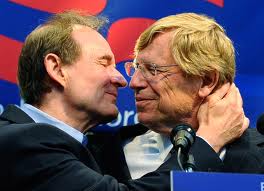
Above is David Boies. Below is George Clooney

Below Mr. Clooney is Theodore Olson


And this is Martin Sheen


What is the connection between these four men? According to the Wall Street Journal Law Blog Mr. Clooney and Mr. Sheen are set to portray Mr. Boies and Mr. Olson, respectively, in a Hollywood version of the play "8." Sometimes, actors get parts because they look a lot like the historical character they are playing. I think we can all agree this is one of those times. No word on whether Mr. Sheen and Mr. Clooney will reenact this scene:


Friday, March 18, 2011

Are pizza lovers more likely to be against gay marriage?

As I discussed in November, the relationship between the Iowa Supreme Court and the citizens of Iowa has become more politicized. Prior to 2010, no Iowa judge had ever lost a retention election. Three Iowa Supreme Court justices lost their retention election in 2010. Bob Vander Plaats, a failed Iowa gubernatorial candidate and gay marriage opponent, helped coordinate the efforts of various special interest groups to bring about the loses.

Now Mr. Vander Plaats is calling upon the four Iowa Supreme Court justices who were not up for retention election to resign. As the Quad Cities' Times reports, Mr. Vander Plaats spooke to 30 people at Wise Guys Pizza as part of his effort to launch a grassroots effort to get rid of the four justices. While Mr. Vander Plaats believes the justices should be impeached, he also thinks that Iowans "should give the remaining four justices the opportunity to do the right thing." If the justices fail to do the right thing, they should be impeached because the Iowa Supreme Court unanimous ruling allowing gay marriage exceeded constitutional limits in a way that amounts to malfeasance warranting impeachment. I find the use of the phrase "do the right thing" strange given that I assume that the justices were trying to do the right thing when they unwittingly provoked the ire of Mr. Vander Plaats.

Mr. Vander Plaats made similar statements on March 14 at a Godfather's Pizza in Cedar Rapids Iowa. There Mr. Vander Plaats said the fact that Iowa allows gay marriage could lead to the legalization of polygamy or incest. Mr. Vander Plaats's argument is similar to the one made by Justice Scalia in Lawrence v. Texas. As I am sure you recall, the Lawrence case is the one where the United States Supreme Court struck down a Texas law against sodomy as unconstitutional. Justice Scalia's dissent, like Mr. Vander Plaat's recent speeches, worried that laws against "bigamy, same-sex marriage, adult incest, prostitution, masturbation, fornication, bestiality, and obscenity" were no longer sustainable.

Mr. Vander Plaats's recent public appearances raise a couple of questions. First is there some link between opponents of gay marriage and pizza (or mafia-themed pizza places)? I worked at a pizza place for several years during and after college and did not notice a connection. Perhaps it is like law school and Mr. Vander Plaats figures that by offering people free pizza he will get them to show up and listen to his arguments against gay marriage.

Second, is there any evidence to support slippery slope argument advanced by Mr. Vander Plaats? At first blush, the answer is no. None of the of the states that have legalized gay marriage (or civil unions) have also legalized incest or polygamy. Moreover, it seems unlikely that any state is going to do so. As University of Minnesota Law School professor Dale Carpenter has noted, polygamous marriage has been tried and rejected by many different cultures over human history. Gay marriage has not. Thus, the comparison between the two is somewhat specious. Moreover, polygamous marriage presents legal problems that do not exist if gay marriage is allowed, e.g., if the husband dies whiteout a will, which wife gets what.

However, it is true that the Lawrence decision has been used to strike down other sex crime laws. For example, in Martin v. Ziherl, the Virgina Supreme Court struck down Virgina's law against fornication was struck down solely on the basis of Lawrence. Also, in Reliable Consultants, Inc., v. Earle, 517 F.3d 738 (2008), the Fifth Circuit struck down a Texas law banning the sale of any devise, to quote the law in question "designed or marketed as useful primarily for the stimulation of human genital organs." So perhaps Mr. Vander Plaats's concern over the expansion of the gay marriage decision is not entirely misplaced.

On the other hand, the Lawrence decision has not prompted Courts to strike down, as Justice Scalia speculated, laws prohibiting incest, prostitution, or obscenity. See e.g., Muth v. Frank, 412 F.3d 808 (7th Cir. 2005)(upholding Wisconsin law prohibiting incest from a challenge based on Lawrence, State v. Lowe, 112 Ohio St.3d 507 (Ohio Ct. App. 2006) (upholding Ohio law prohibiting incest, State v. Romano, 114 Hawai'i 1 (2007) (holding laws prohibiting prostitution from a Lawrence challenge, U.S. v. Stagliano, 693 F. Supp.2d 25 (D.D.C. 2010) (finding Lawrence does not render laws against obtaining or distributing obscene material unconstitutional).

All of this is a long way of saying that while Mr. Vander Plaats' arguments may or may not be misplaced, Iowa's retention elections in 2012 and 2014 are apparently going to be as contentious as the one in 2010. Do we think that is a good thing?

Friday, August 27, 2010

Throw the bums out?

Interesting article in the Washington Post about a campaign in Iowa to unseat three members of the Iowa Supreme Court, primarily in response to that court's unanimous decision last year overturning the state's law banning same-sex marriage.  Supporters of the campaign say they are trying to send a message about "judicial activism":
"We need to vote them off the bench to send a message across Iowa that we, the people, still have the power," said Bob Vander Plaats, a Republican politician who is spearheading the campaign. "Not only will it send a message here in Iowa, but it will send a message in California, in Arizona and across the country that the courts have really taken on too much power."
But Iowa has a "retention election" system for judges--so the three judges are not actually running against anyone.  Iowa voters will simply have a chance to vote them off the bench, and, in that case, they would be replaced by the governor after a merit selection process.

Some people think the campaign is an inappropriate use of the retention election process:

"I've used the word 'vengeance' before in describing what this campaign is about," said [Former Supreme Court justice Mark McCormick], now a lawyer in private practice. "I think it is a challenge to judicial independence. There's an effort being made to succeed in turning out of office these three good judges for an inappropriate reason."
He and others worry it will politicize Iowa's court system and have a chilling effect on judges nationwide.
My own guess is that the temperamentally conservative Iowa electorate will ultimately reject the campaign and vote to retain the justices.   I also think the nature of this campaign highlights the benefits of a retention-election system over a regular judicial election.  If these were regular judicial elections, this campaign would have drafted ideologically driven lawyer-candidates to run against the justices, who in turn likely would have forced awkward debates about decisions in specific cases.  Instead, the Iowa campaign is more or less forced to cloak itself in an general attack on "judicial activism"--which at least strikes me as a legitimate debate to have voters weigh in on in a judicial contest.

Mr. Gillette:  what are you thoughts, as a native Iowan? 

Saturday, August 7, 2010

More on Judge Walker

One of my random questions about the Prop 8 case was whether it mattered at all that Judge Walker is supposedly gay.  In a short profile of Judge Walker, New York Times reporter John Schwartz address this issue at some length:

[S]everal published reports have stated that [Judge Walker] is himself gay. In February, The San Francisco Chronicle called it an “open secret.” Critics have argued that his sexual orientation was a source of bias that should have disqualified him from hearing the Proposition 8 case. Judge Walker has declined to discuss the matter.
Monroe H. Freedman, an expert in legal ethics at Hofstra Law School, said that while bias could lead to recusal in rare cases, “you could say, ‘If a gay judge is disqualified, how about a straight judge?’ There isn’t anybody about whom somebody might say, ‘You’re not truly impartial in this case.’ ”
Mr. Freedman cited a 1975 opinion by Judge Constance Baker Motley of Federal District Court, an African-American jurist who was asked to disqualify herself from a lawsuit alleging unlawful discrimination. “If background or sex or race of each judge were, by definition, sufficient grounds for removal, no judge on this court could hear this case, or many others,” she wrote.

I agree with Mr. Freedman and Judge Motley.  But it seems to me there's a deeper point here.  Apparently this issue is so well-settled and accepted that the attorneys defending Prop 8 didn't even think it was worth raising.  This is another sign of how much our culture has changed in its treatment of gays--now a gay judge presiding in a court trial over a momentous issue of gay rights is simply unremarkable, even to zealous advocates.  However the Prop 8 comes out after the appeals, I think the fact that a gay judge was allowed to act as the trial judge without so much as a peep is a sure sign the campaign for gay rights and gay marriage will ultimately succeed.

This brings to mind some of the early controversy surrounding Justice Kagan's sexual orientation.  As you'll recall, there was a report on cbsnews.com stating that Kagan is gay.  Kagan said nothing, but the White House criticized the report as containing "false charges."  Then there was a lot of teeth-gnashing among pundits about whether it should even matter.

I always thought it--the truth about Kagen's sexuality--mattered, though not to whether she is qualified to serve on the Supreme Court (as she clearly is).  If we are actually supposed care about diversity or "empathy" -- and maybe we actually aren't -- then it matters.  Moreover, having an openly gay member of the Supreme Court would be another big step for gay rights, no?  On the other hand, another closeted member of the Supreme Court would seem to be a step back.  Either way, the truth matters.