Showing posts with label The nature of reality. Show all posts
Showing posts with label The nature of reality. Show all posts
Friday, April 4, 2014
Being the champion and the nature of reality.
Given his love of basketball, I am a little surprised that Mr. Torvik has not already pointed out that our joint alma mater, the University of Minnesota, won the NIT men's basketball championship last night. Some might say that the Golden Gophers are one of two national champions in men's college basketball. Given that the other tournament, run by NCAA, contains 68 teams, others might say this means the Gophers are the 69th best team in the country. It's all a matter of perspective.

Monday, March 24, 2014
Major League Baseball and the nature of reality (part two)
Jack Moore at Sports on Earth has a post about how the Detroit Tigers have reached an impasse in talks to extend their contract with pitcher Max Scherzer. Mr. Scherzer won the American League Cy Young Award last season and is a big part of the Tigers' hopes on winning the American League Central Division and more this season.
Monday, July 22, 2013
Mot Juste?
With the news that Milwaukee Brewers' slugger Ryan Braun is being suspended for the remainder of the baseball season, it might not hurt to review Mr. Torvik's excellent post about Mr. Braun from the last time he was in trouble for using performance enhancing drugs.
Also, Frank Schwab at Yahoo Sports does a nice job of reminding people that Packers' quarterback Aaron Rodgers was a bit of a knucklehead when it came to Mr. Braun.
Also, Frank Schwab at Yahoo Sports does a nice job of reminding people that Packers' quarterback Aaron Rodgers was a bit of a knucklehead when it came to Mr. Braun.
Monday, April 30, 2012
Cereal and the nature of reality: "natural" does not equal "organic."
The USA Today, a paper Homer Simpson described as "the only paper in America that's not afraid to tell the truth, that everything is just fine," has a story about how some folks are distressed to learn that Kashi cereals are "natural" but not "organic."
Friday, April 20, 2012
Facts, R.I.P.?
The Chicago Tribune has published an obituary of Facts:
To the shock of most sentient beings, Facts died Wednesday, April 18, after a long battle for relevancy with the 24-hour news cycle, blogs and the Internet. Though few expected Facts to pull out of its years-long downward spiral, the official cause of death was from injuries suffered last week when Florida Republican Rep. Allen West steadfastly declared that as many as 81 of his fellow members of theU.S. House of Representatives are communists.The Gillette-Torvik Blog has done its part covering this story in its Poolitzer-Prize-winning series entitled, "The Nature of Reality."
Friday, February 24, 2012
Major League Baseball and the nature of reality
Ryan Braun, the Milwaukee Brewers slugger and reigning National League MVP, will not be suspended for violating Major League Baseball's policy on banned substances. Normally, the lack of a suspension would not be news because allegations of a failed drug test are supposed to be confidential until the penalty is imposed. So, in the normal case, either a suspension is announced or nobody ever knows anything happened. In this case, though, the allegation that Braun failed a drug test was leaked to ESPN while the process was pending. Under those circumstances, Braun and his circle were perfectly happy to publicize the fact that he had been #exonerated.
Friday, February 3, 2012
Hollywood and the subjective nature of reality


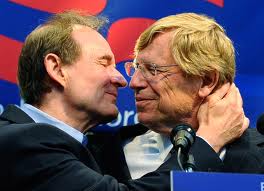
Below Mr. Clooney is Theodore Olson

And this is Martin Sheen


What is the connection between these four men? According to the Wall Street Journal Law Blog Mr. Clooney and Mr. Sheen are set to portray Mr. Boies and Mr. Olson, respectively, in a Hollywood version of the play "8." Sometimes, actors get parts because they look a lot like the historical character they are playing. I think we can all agree this is one of those times. No word on whether Mr. Sheen and Mr. Clooney will reenact this scene:
Thursday, February 2, 2012
Appellate Courts and the nature of reality
It appears that the curious case of Gallop v. Cheney is over. The case is one filed by "Truthers," people who believe that the events surrounding the 9-11 attacks are not what most people believe.
April Gallop, a soldier working in the Pentagon on 9-11, filed a complaint in the United States District Court for the Southern District of New York, alleging that a plane did not crash into the Pentagon on 9-11. Instead, Vice-President Cheney and other senior civilian and military leaders arranged for explosive charges to be detonated in the Pentagon to give the false impression that a plane had crashed into the building. As an aside, Ms. Gallop apparently agrees that planes actually did hit the World Trade Center. However, Ms. Gallop believes that the government officials she sued knew about the attacks in advance and did not stop them because they wished to "enact and implement radical changes in the policy and practice of constitutional government." The attack at the Pentagon was designed to conceal the revelation that $2.3 trillion in congressional appropriations could not be accounted for by the Department of Defense.
Unsurprisingly, the district court dismissed Ms. Gallop's complaint as frivolous. Then, to borrow a phrase from the late Hunter S. Thompson, the going got weird. Ms. Gallop filed an appeal. The Second Circuit Court of Appeals affirmed the district court's dismissal of the case. However, the appellate court also sanctioned Ms. Gallop and her attorneys because the appeal was "brought without the slightest chance of success." You can read that opinion here. In making the sanctions decision, the court told Ms. Gallop and her attorneys to figure out who of them was responsible for the appeal.
It evidently did not take too much time to figure out who was responsible for the appeal because during the period that was supposed to being taking place Ms. Gallop requested that the Second Circuit here the case en banc. She also asked that the judges who initially ruled on her appeal recuse themselves and that any members of the Second Circuit who "shared the feelings" of the initial judges also recuse themselves. That led to this order, where the Second Circuit sanctioned one of Ms. Gallop's attorneys again.
In October, the Second Circuit issued it's sanctions order. It is here. In it, the Second Circuit declined to sanction Ms. Gallop but found that her attorneys should jointly be sanctioned $15,0000. The sanction didn't go over too well with her attorneys and they asked the sanction order also be considered en banc. Today, the Court issued its decision slightly modifying the sanctions order. It is here.
In one sense, the decision is a win for at least one of Ms. Gallop's attorneys. The local counsel, Mustapha Ndanusa was not sanctioned. However, that didn't mean that the sanction amount was lowered. Instead, the remaining two attorneys, Dennis Cunningham and William Veale, were on the hook for the entire $15,000.
The Second Circuit rejected the use by Mr. Cunningham and Mr. Veale of what Mr. Torvik might label the "Isaiah Lewis Defense." Put another way, Mr. Cunnigham and Mr. Veale argued they shouldn't be sanctioned because they truly believe that the government planned the attack on the Pentagon. That belief turned out to be irrelevant for the sanctions motion because the Second Circuit sort of moved the goalposts. The sanctions were not being imposed for the original appeal. They were being imposed because of the recusal motion. Essentially, the court said since there was no authority for the proposition that an entire circuit should recuse themselves for sharing the beliefs of the orignal panel, then the recusal motion was therefore sanctionable.
I suppose that Mr. Cunningham and Mr. Veale might feel vindicated that their views on 9-11 were not the source of the sanction. As a general rule it is probably a good thing if courts don't sanction folks simply for being reality-challenged. On the other hand, this sanction sort of feels like cheating. A review of the orders suggests that Mr. Cunningham and Mr. Veale didn't think (or perhaps didn't understand) that the requested result of their recusal motion was the thing they were supposed to being defending to the court. This sort of makes the sanctions order feel like the result of a hyper-technical argument or trick. What do you think Mr. Torvik, did the court use a "gotcha!" approach in order to impose sanctions?
Thursday, January 19, 2012
The Iowa Caucuses and The Nature of Reality
Who won the Republican Iowa Caucuses?
It depends on when you ask.
Back when the answer mattered, they told us that Mitt Romney won, by 8 votes or so.
Now, when we are simply writing history, they tell us that Rick Santorum won, by 34 votes or so. Or so. It turns out that eight Iowa precincts did not turn in their final tallies by the deadline, so the votes in those precincts will never be counted. (At least until, at some point in the future, somebody decides to count them.)
So who won the GOP's Iowa caucuses? The terrorists won.
It depends on when you ask.
Back when the answer mattered, they told us that Mitt Romney won, by 8 votes or so.
Now, when we are simply writing history, they tell us that Rick Santorum won, by 34 votes or so. Or so. It turns out that eight Iowa precincts did not turn in their final tallies by the deadline, so the votes in those precincts will never be counted. (At least until, at some point in the future, somebody decides to count them.)
So who won the GOP's Iowa caucuses? The terrorists won.
Thursday, January 5, 2012
College Basketball and the Nature of Reality
It has been a rough week for me as a fan of the Wisconsin Badgers. First, the basketball team lost to lowly Iowa at home. Then the football team lost in the Rose Bowl. Then, on Tuesday, the basketball team lost again at home, this time to arch-rival Michigan State, in overtime.
For one ecstatic moment, however, it seemed that the game was headed for a second overtime. Forward Ryan Evans banked in a three to tie the game just before the buzzer sounded. The clock on the screen while the play was happening clearly had not yet struck zero. It was great.
But then the madness began. The clock on the screen wasn't the official clock! And the "official clock"—the one above the backboard—was all zeroes when Evans let the shot go. Here's the definitive picture that shows both clocks:

This is inexplicable. One possible explanation is that the clocks got screwed up when the refs went to the monitor with 20.1(or 20.3?) seconds left to make sure the clock had stopped at exactly the right time. But I prefer an explanation rooted in the not-so-immutable physical laws of the universe. Put simply, simultaneity is relative.
For one ecstatic moment, however, it seemed that the game was headed for a second overtime. Forward Ryan Evans banked in a three to tie the game just before the buzzer sounded. The clock on the screen while the play was happening clearly had not yet struck zero. It was great.
But then the madness began. The clock on the screen wasn't the official clock! And the "official clock"—the one above the backboard—was all zeroes when Evans let the shot go. Here's the definitive picture that shows both clocks:
This is inexplicable. One possible explanation is that the clocks got screwed up when the refs went to the monitor with 20.1(or 20.3?) seconds left to make sure the clock had stopped at exactly the right time. But I prefer an explanation rooted in the not-so-immutable physical laws of the universe. Put simply, simultaneity is relative.
Wednesday, December 21, 2011
College Football and the Nature of Reality
I spend much of my free time following sports. In my lucid moments, rare as they are, I find this use of time hard to justify. What do I get out of following sports? Does it make me a better person? Does it make the world a better place?
As you can imagine, I've been able to come up with quite a few justifications (i.e., rationalizations) over the years. But today, for the first time, my sports-following habit provoked me to reflect on the nature of reality. The specific impetus for this is the controversy surrounding the decisive play in the recent Big Ten Football Championship game, in which the Wisconsin Badgers beat Michigan State in a thrilling comeback.
The decisive play was a penalty. Wisconsin, up by 3, was forced to punt with just about a minute left in the game. Michigan State returned the punt all the way to the three-yard line, but was flagged for "running into the kicker." Safety Isaiah Lewis committed the foul.

The result of the penalty was a first down for the Badgers, which allowed them to assume the victory formation and run out the clock.
When an official makes such a game-deciding call, there will be controversy. There are two points of contention about this particular play: (1) Did Lewis actually run into the punter? (2) Did the punter flop?
There really can be no dispute that the answer to both questions is "yes." The still photo included here shows clearly that Lewis did run into the punter's legs while he was in the kicking motion. The video of the play also shows that after this moment the punter twirled to his left, far more violently that the contact itself would seem to have caused.
Thus, the only real question is whether Lewis's contact with the punter was "incidental," as incidental contact with a kicker is not a foul. The referee's judgment that the contact was not incidental is defensible, I think, because Lewis made contact with the legs of the punter while the punter was in his punting motion. The purpose of the rule is to protect the punter while he in this very vulnerable position, so any contact made with the legs at that moment cannot be incidental. In all my years of watching football, I have never seen contact like this not called a penalty.
Some maintain, however, that Lewis did not even touch the punter. Among those who hold this belief, apparently, is Lewis himself, the person who did in fact run into the punter. Lewis reviewed the tape and said, "personally, I didn't feel like I hit the guy."
How can this be?
I'll admit the statement is ambiguous. He says he "didn't" feel like he hit the guy. This leaves open the possibility that what he's saying is just that he didn't think he hit him at the time. That would certainly be understandable. Football players are well-armored, so in the heat of the moment it's possible that Lewis didn't notice the impact from the somewhat glancing contact he made with the punter.
Still, Lewis seems to be maintaining that he actually still believes he didn't hit the punter, when the tape shows clearly that he did. But perhaps the key words in his statement are "personally" and "feel"; he says he "personally" doesn't "feel like" he hit the guy. This seems to be an assertion that reality is subjective, and the videotape is no greater evidence of what really happened than his own visceral memory. There are no facts, only feelings.
Or, in other words, "Who are you going to believe—me or your lying eyes?"
In the end, of course, the only reality that matters is the one that the referee saw, and made. And in that reality, the Badgers are going to the Rose Bowl. Again.
As you can imagine, I've been able to come up with quite a few justifications (i.e., rationalizations) over the years. But today, for the first time, my sports-following habit provoked me to reflect on the nature of reality. The specific impetus for this is the controversy surrounding the decisive play in the recent Big Ten Football Championship game, in which the Wisconsin Badgers beat Michigan State in a thrilling comeback.
The decisive play was a penalty. Wisconsin, up by 3, was forced to punt with just about a minute left in the game. Michigan State returned the punt all the way to the three-yard line, but was flagged for "running into the kicker." Safety Isaiah Lewis committed the foul.

The result of the penalty was a first down for the Badgers, which allowed them to assume the victory formation and run out the clock.
When an official makes such a game-deciding call, there will be controversy. There are two points of contention about this particular play: (1) Did Lewis actually run into the punter? (2) Did the punter flop?
There really can be no dispute that the answer to both questions is "yes." The still photo included here shows clearly that Lewis did run into the punter's legs while he was in the kicking motion. The video of the play also shows that after this moment the punter twirled to his left, far more violently that the contact itself would seem to have caused.
Thus, the only real question is whether Lewis's contact with the punter was "incidental," as incidental contact with a kicker is not a foul. The referee's judgment that the contact was not incidental is defensible, I think, because Lewis made contact with the legs of the punter while the punter was in his punting motion. The purpose of the rule is to protect the punter while he in this very vulnerable position, so any contact made with the legs at that moment cannot be incidental. In all my years of watching football, I have never seen contact like this not called a penalty.
Some maintain, however, that Lewis did not even touch the punter. Among those who hold this belief, apparently, is Lewis himself, the person who did in fact run into the punter. Lewis reviewed the tape and said, "personally, I didn't feel like I hit the guy."
How can this be?
I'll admit the statement is ambiguous. He says he "didn't" feel like he hit the guy. This leaves open the possibility that what he's saying is just that he didn't think he hit him at the time. That would certainly be understandable. Football players are well-armored, so in the heat of the moment it's possible that Lewis didn't notice the impact from the somewhat glancing contact he made with the punter.
Still, Lewis seems to be maintaining that he actually still believes he didn't hit the punter, when the tape shows clearly that he did. But perhaps the key words in his statement are "personally" and "feel"; he says he "personally" doesn't "feel like" he hit the guy. This seems to be an assertion that reality is subjective, and the videotape is no greater evidence of what really happened than his own visceral memory. There are no facts, only feelings.
Or, in other words, "Who are you going to believe—me or your lying eyes?"
In the end, of course, the only reality that matters is the one that the referee saw, and made. And in that reality, the Badgers are going to the Rose Bowl. Again.
Subscribe to:
Posts (Atom)