Recently, the Supreme Court decided the case of Pacific v. Valladolid. It is a decidedly unsexy case, and its ruling did not provoke any headlines in the New York Times. The unsexy issue: whether the Longshore and Harbor Worker's Compensation Act extends to an employee who died on land rather than at sea, if the death had a "substantial nexus" to his work at sea. According to the Supreme Court, it does.
Why is this bloggable?
First, the opinion was unanimous. There was no ideological split, though Alito and Scalia did file a separate opinion concurring in part and concurring in the judgment.
Second, the case came up from the Ninth Circuit, which the Supreme Court famously likes to smack down. And the Ninth Circuit's opinion was in conflict with two other circuits which had decided the issue, so it may have seemed ripe for a smackin'.
Third, the losing party in this case was Big Oil, which (along with all other big businesses) the Supreme Court supposedly kowtows to.
Fourth, the majority opinion, written by Justice Thomas, uses textual analysis to reach a result that favors the little guy—in this case a manual laborer whose job was known in the trade as a "roustabout." This would seem to refute the argument that textualism is just a smokescreen that judges use to get the results that they subjectively prefer. (For another example, see this prior post.)
In other words, this case should make you question your cynicism.
Friday, February 3, 2012

Hollywood and the subjective nature of reality


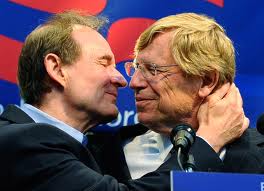
Below Mr. Clooney is Theodore Olson

And this is Martin Sheen


What is the connection between these four men? According to the Wall Street Journal Law Blog Mr. Clooney and Mr. Sheen are set to portray Mr. Boies and Mr. Olson, respectively, in a Hollywood version of the play "8." Sometimes, actors get parts because they look a lot like the historical character they are playing. I think we can all agree this is one of those times. No word on whether Mr. Sheen and Mr. Clooney will reenact this scene:
Thursday, February 2, 2012
Appellate Courts and the nature of reality
It appears that the curious case of Gallop v. Cheney is over. The case is one filed by "Truthers," people who believe that the events surrounding the 9-11 attacks are not what most people believe.
April Gallop, a soldier working in the Pentagon on 9-11, filed a complaint in the United States District Court for the Southern District of New York, alleging that a plane did not crash into the Pentagon on 9-11. Instead, Vice-President Cheney and other senior civilian and military leaders arranged for explosive charges to be detonated in the Pentagon to give the false impression that a plane had crashed into the building. As an aside, Ms. Gallop apparently agrees that planes actually did hit the World Trade Center. However, Ms. Gallop believes that the government officials she sued knew about the attacks in advance and did not stop them because they wished to "enact and implement radical changes in the policy and practice of constitutional government." The attack at the Pentagon was designed to conceal the revelation that $2.3 trillion in congressional appropriations could not be accounted for by the Department of Defense.
Unsurprisingly, the district court dismissed Ms. Gallop's complaint as frivolous. Then, to borrow a phrase from the late Hunter S. Thompson, the going got weird. Ms. Gallop filed an appeal. The Second Circuit Court of Appeals affirmed the district court's dismissal of the case. However, the appellate court also sanctioned Ms. Gallop and her attorneys because the appeal was "brought without the slightest chance of success." You can read that opinion here. In making the sanctions decision, the court told Ms. Gallop and her attorneys to figure out who of them was responsible for the appeal.
It evidently did not take too much time to figure out who was responsible for the appeal because during the period that was supposed to being taking place Ms. Gallop requested that the Second Circuit here the case en banc. She also asked that the judges who initially ruled on her appeal recuse themselves and that any members of the Second Circuit who "shared the feelings" of the initial judges also recuse themselves. That led to this order, where the Second Circuit sanctioned one of Ms. Gallop's attorneys again.
In October, the Second Circuit issued it's sanctions order. It is here. In it, the Second Circuit declined to sanction Ms. Gallop but found that her attorneys should jointly be sanctioned $15,0000. The sanction didn't go over too well with her attorneys and they asked the sanction order also be considered en banc. Today, the Court issued its decision slightly modifying the sanctions order. It is here.
In one sense, the decision is a win for at least one of Ms. Gallop's attorneys. The local counsel, Mustapha Ndanusa was not sanctioned. However, that didn't mean that the sanction amount was lowered. Instead, the remaining two attorneys, Dennis Cunningham and William Veale, were on the hook for the entire $15,000.
The Second Circuit rejected the use by Mr. Cunningham and Mr. Veale of what Mr. Torvik might label the "Isaiah Lewis Defense." Put another way, Mr. Cunnigham and Mr. Veale argued they shouldn't be sanctioned because they truly believe that the government planned the attack on the Pentagon. That belief turned out to be irrelevant for the sanctions motion because the Second Circuit sort of moved the goalposts. The sanctions were not being imposed for the original appeal. They were being imposed because of the recusal motion. Essentially, the court said since there was no authority for the proposition that an entire circuit should recuse themselves for sharing the beliefs of the orignal panel, then the recusal motion was therefore sanctionable.
I suppose that Mr. Cunningham and Mr. Veale might feel vindicated that their views on 9-11 were not the source of the sanction. As a general rule it is probably a good thing if courts don't sanction folks simply for being reality-challenged. On the other hand, this sanction sort of feels like cheating. A review of the orders suggests that Mr. Cunningham and Mr. Veale didn't think (or perhaps didn't understand) that the requested result of their recusal motion was the thing they were supposed to being defending to the court. This sort of makes the sanctions order feel like the result of a hyper-technical argument or trick. What do you think Mr. Torvik, did the court use a "gotcha!" approach in order to impose sanctions?
Is it a felony to videotape a police officer on the job in Illinois?
The short answer is yes.
Should it be?
Consider this, one of my favorite Supreme Court passages (from City of Houston v. Hill):
It seems to me that if there is a right to shout at the police—and there is—there should also be a right to document their official activities in public.
UPDATE:
See here for an update regarding judicial and legislative action on this law..
Should it be?
Consider this, one of my favorite Supreme Court passages (from City of Houston v. Hill):
The Constitution does not allow such speech to be made a crime. The freedom of individuals verbally to oppose or challenge police action without thereby risking arrest is one of the principal characteristics by which we distinguish a free nation from a police state.That case struck down a law that made it a crime "for any person to assault, strike or in any manner oppose, molest, abuse or interrupt any policeman in the execution of his duty," which had been used to justify the arrest of a bystander for "verbal challenge [of a police officer] during an investigation." The specific "verbal challenge" was: "Why don't you pick on somebody your own size?"
It seems to me that if there is a right to shout at the police—and there is—there should also be a right to document their official activities in public.
UPDATE:
See here for an update regarding judicial and legislative action on this law..
Tuesday, January 31, 2012
Newt Gingrich has a pretty bad day.
As part of our continuing series on people who will never be president but are running for president, we should point out that things are not going well for Newt Gingrich. Mitt Romney has already claimed victory in today's Florida primary. Also, 80s one-hit wonder Survivor is suing Mr. Gingrich because he has been using "Eye of the Tiger" at his campaign stops without their permission. Maybe Mr. Gingrich can settle with the band by getting them something from Tiffany's.
Monday, January 30, 2012
Thursday, January 26, 2012
An unjust situation? Maybe not.
I was looking at the post on the legal blog Above the Law today. For whatever reason, this post caught my eye. Perhaps it was the post's title "Even a Bargained For Search of Breasts Can Be Pretty Damn Illegal If You’re a Cop"
The post is about, as the author puts it, the "nexus of abusive police power and drunk co-eds." It seems that a campus police officer at Central Michigan University recently bet two female students that their blood alcohol levels were higher than 0.05%. If the police officer won the bet, the girls were supposed to expose their breasts to the officer. The girls lost the bet.
The post is about, as the author puts it, the "nexus of abusive police power and drunk co-eds." It seems that a campus police officer at Central Michigan University recently bet two female students that their blood alcohol levels were higher than 0.05%. If the police officer won the bet, the girls were supposed to expose their breasts to the officer. The girls lost the bet.
The post goes on to say the officer has:
Before I go further, in the author's defense the AP story he linked to does not give all the facts. However, the AP story does say it is relying on reporting from the local paper in Mount Pleasant, Michigan—The Morning Sun. The Morning Sun story goes into a bit more detail.
According to the Morning Sun, Jeffrey Allen Card, pleaded guilty on the day his trial was to begin. Mr. Card was on his patrol when two female students asked him for a ride home. Instead of giving them a ride home, he drove them out of town and made the "bet" about the students' blood alcohol content. The students showed the Mr. Card their breasts. Mr. Card didn't take the students back to their dorm until his dispatcher called asking Mr. Card to return to campus. Also, according to a CBS news report done at the time the incident was reported, Card took pictures of the students on the back of his squad car.
Three observations: first, the situation seems a lot more ominous than what the Above the Law author thought. The officer did just ask to see the women's breasts, he arguably abducted them. I don't know what penalty the judge on Mr. Card, but jail doesn't seem like an unjust situation to me. Second, Mr. Card wasn't found guilty, he pleaded guilty. If we adopt the formulation used by Above the Law, Mr. Card made a bargain. So, presumably Mr. Card didn't think the possible sentence was too harsh compared to the trial. Third, Google tells me that the search I ran to get the full story on Mr. Card took .21 seconds. Just saying. Finally, none of the stories seem to answer the question that made me search Mr. Card in the first place: what did the students get if Mr. Card lost?
pleaded guilty to misconduct, and could be looking at five years in prison. At first blush, that sounds like a heavy price to pay for essentially saying, “show me your tits.”
But that’s probably just the testosterone talking. The AP story doesn’t give us all the facts. We don’t know if this was a stupid little game between some kids and a guy trying to play along, or a coercive encounter between a person of authority and relatively defenseless college students. The police get away with enough in this country that I’m comfortable if the ambiguity is read in favor of the college kids.
But incarceration feels like a bit much. Fire him, take away his pension or something. Let’s make sure that the next time he wants a free show, he’s got to throw away some beads instead of flashing a badge. But I’m not sure that running around making bets with co-eds over a flash really constitutes a menace to society that needs to be punished with prison.So the author thinks that the possible penalty for the guilty plea is too high because, as the title says, the incident was just a "bargain." It might have been a bargain but it wasn't an arm's length transaction between parties of equal bargaining power.
Before I go further, in the author's defense the AP story he linked to does not give all the facts. However, the AP story does say it is relying on reporting from the local paper in Mount Pleasant, Michigan—The Morning Sun. The Morning Sun story goes into a bit more detail.
According to the Morning Sun, Jeffrey Allen Card, pleaded guilty on the day his trial was to begin. Mr. Card was on his patrol when two female students asked him for a ride home. Instead of giving them a ride home, he drove them out of town and made the "bet" about the students' blood alcohol content. The students showed the Mr. Card their breasts. Mr. Card didn't take the students back to their dorm until his dispatcher called asking Mr. Card to return to campus. Also, according to a CBS news report done at the time the incident was reported, Card took pictures of the students on the back of his squad car.
Three observations: first, the situation seems a lot more ominous than what the Above the Law author thought. The officer did just ask to see the women's breasts, he arguably abducted them. I don't know what penalty the judge on Mr. Card, but jail doesn't seem like an unjust situation to me. Second, Mr. Card wasn't found guilty, he pleaded guilty. If we adopt the formulation used by Above the Law, Mr. Card made a bargain. So, presumably Mr. Card didn't think the possible sentence was too harsh compared to the trial. Third, Google tells me that the search I ran to get the full story on Mr. Card took .21 seconds. Just saying. Finally, none of the stories seem to answer the question that made me search Mr. Card in the first place: what did the students get if Mr. Card lost?
Wednesday, January 25, 2012
Albert Brooks is funny and also handles disappointment well.
As Richard Roeper of the Chicago Sun-Times notes, the Academy of Motion Picture Arts and Sciences snubbed a fair number of people this year when picking the nominees for the Academy Awards. Albert Brooks was one of the actors who didn't get nominated. As his Twitter feed shows, Mr. Brooks is handling his disappointment with aplomb. Read his tweets here.
Tuesday, January 24, 2012
R.I.P. Judge Wesley Brown
The Gillette-Torvik blog is saddened to learn of the death of Judge Wesley Brown. Judge Brown was a judge in the United States District Court in the District of Kansas and the oldest sitting judge in the country's history. He was 104 and still hearing matters in 2011. The Wichita Eagle has a nice summary of the judge's accomplishments here.
Incredibly, Judge Brown was not the longest tenured judge in our nation's history. That title belogns to Judge Joseph Woodrough. He was a district court judge in Nebraska and then a judge on the 8th Circuit, for a total of judge for 61 years. However, according to Wikipedia, Judge Woodrough did not perform any judicial duties the last 16 years of his life. So in terms of active service, Judge Brown has the record.
At 104, Judge Brown was not particularly close to hitting oldest person in the world status. One hopes this means that he was not targeted by the serial killer that we discussed here.
Incredibly, Judge Brown was not the longest tenured judge in our nation's history. That title belogns to Judge Joseph Woodrough. He was a district court judge in Nebraska and then a judge on the 8th Circuit, for a total of judge for 61 years. However, according to Wikipedia, Judge Woodrough did not perform any judicial duties the last 16 years of his life. So in terms of active service, Judge Brown has the record.
At 104, Judge Brown was not particularly close to hitting oldest person in the world status. One hopes this means that he was not targeted by the serial killer that we discussed here.
Friday, January 20, 2012
A Gillette-Torvik Conversation™: The Montana Corporate Speech Case — PART FIVE
[Here are parts one, two, three, and four.]
TORVIK: The concept of corporate personhood does not affront my human dignity. The principle that corporations are entitled to certain constitutional rights is an old and well-established one. So if it were injurious to human dignity, the damage would presumably already be done. But perhaps I just don't know what it is like to feel fully dignified. Though I am frequently indignant.
When you think about it, it's pretty clear that corporations and other entities must have certain rights but not others. For example, no one would think it proper under the Fourth Amendment for the government to raid the ACLU's (or even IBM's) headquarters without a warrant. See Hale v. Henkel, 201 U.S. 43, 76 (1906). But few would bat an eye at the proposition that corporations lack the privilege against self-incrimination granted by the Fifth Amendment. Id. Why this different instinct? One idea: some rights are personal (such as the privilege against self-incrimination) and other rights are more structural (like the right to be free from unreasonable searches and seizures). The privilege against self-incrimination seems to flow from an idea that there's something wicked about forcing an actual human being to testify against himself. The right to be free from unreasonable searches, on the other hand, has more to do with proper government structure—i.e., ensuring that the government is not tyrannical. (Though, to be sure, there's an element of a personal privacy right in the Fourth Amendment also.)
So maybe one's reaction to Citizens United comes down to whether one thinks the right to engage in political speech (and to spend money to amplify that speech) is more like a personal right or a structural right. This strikes me as a question about which reasonable minds can disagree. If your theory of the First Amendment is that it exists to foster personal self-fulfillment and autonomy, you probably don't think protecting corporate speech makes much sense, and you might even be offended by it. But if your theory is that the First Amendment exists to encourage a free-wheeling exchange in the marketplace of ideas, then you probably just say "the more the merrier," whomever (or whatever) the speaker is. Since I'm provisionally in the latter camp, I don't think the dignity of the species is at stake.
GILLETTE: It is a mildly amusing thought experiment to scroll through the Amendments to the Constitution and decide which ones apply to “people people” and which ones apply to “corporate people.” Corporations can’t vote, bear arms, invoke the right to not testify, or run for office (to stretch the 22nd Amendment). On the other hand, corporations do get to take advantage of the rights to free speech, be free of unreasonable searches and seizures, and free from being forced to quarter soldiers in peacetime. At least I assume that corporations are protected by the Third Amendment; no case actually discusses the issue. In fact, it appears that there is only one case that has ever been decided solely on Third Amendment grounds, Engblom v. Carey, 677 F.2d 957 (2nd Cir. 1982).
GILLETTE: It is a mildly amusing thought experiment to scroll through the Amendments to the Constitution and decide which ones apply to “people people” and which ones apply to “corporate people.” Corporations can’t vote, bear arms, invoke the right to not testify, or run for office (to stretch the 22nd Amendment). On the other hand, corporations do get to take advantage of the rights to free speech, be free of unreasonable searches and seizures, and free from being forced to quarter soldiers in peacetime. At least I assume that corporations are protected by the Third Amendment; no case actually discusses the issue. In fact, it appears that there is only one case that has ever been decided solely on Third Amendment grounds, Engblom v. Carey, 677 F.2d 957 (2nd Cir. 1982).
The fact that the First Amendment applies discusses “the press” and the “establishment of religion” certainly suggests that the Framers thought that the amendment applied to organizations. After all, virtually every religion has some sort of organization or hierarchical structure. The same is true for “the press.” It would be strange to think that freedom of the press only means freedom of the human printer not the freedom of the company owning the newspaper. One might also point out that the First Amendment’s prohibition is on the Government’s ability to prohibit any speech (“Congress shall pass no law”) not just speech by “people people.” Moreover the amendment is not a grant of a right to the people (although granting a right to the people would be weird given that the Constitution is written by “We the People.”).
To me it isn’t necessarily about self-fulfillment or the marketplace of ideas. It’s more along the lines of the Eugene Volokh hypothetical you brought to my attention. If we say that corporations don’t have first amendment rights, then that rule is going to apply to corporations whose speech I support as well as those whose speech I don’t. I don’t regard that as a good trade.
Speaking of corporate speech, John Stewart and Stephen Colbert do a nice job of illustrating the bogus nature of laws preventing candidates from coordinating advertisement campaigns with the Super-Pacs that support them.
TORVIK: Let me make clear that the Gillette-Torvik Blog believes that it has the right to be free from being forced to quarter soldiers in peacetime.
I think your instinct that a ban on corporate speech would stifle lots of speech that you like masks a deeper principle. I don't think your judgment is that you approve of allowing corporate speech just because, on the whole, you think that it will allow enough speech that you like. I think the underlying judgment is that there is something wrong with stifling the corporate speech that you like, and you have to admit that the same principle must apply to the corporate speech that you don't like.
Anyhow, I think we've come to some consensus. Corporations do have some rights, including some free speech rights. But like any rights they are susceptible to reasonable regulation. I think there's probably a lot of ways to nibble around the edges of corporate speech rights to satisfy the pragmatic concerns of Citizens United's opponents. But—to bring things back to the Montana case that got us off on this—my great disappointment with Western Tradition is that it makes such a poor effort at making any persuasive distinctions. Those will have to await a future case. So we'll have to wait probably about five minutes.
Finally, I want to reiterate my belief that most of these attempts to limit the role of money in politics are futile. I support disclosure laws and those kinds of things, but I think in the end we'd probably be better off with fewer restrictions on political spending rather than more.
Subscribe to:
Posts (Atom)